Chart of the Week
Clean power growth exceeded the rise in global electricity demand in 2025, keeping fossil generation flat
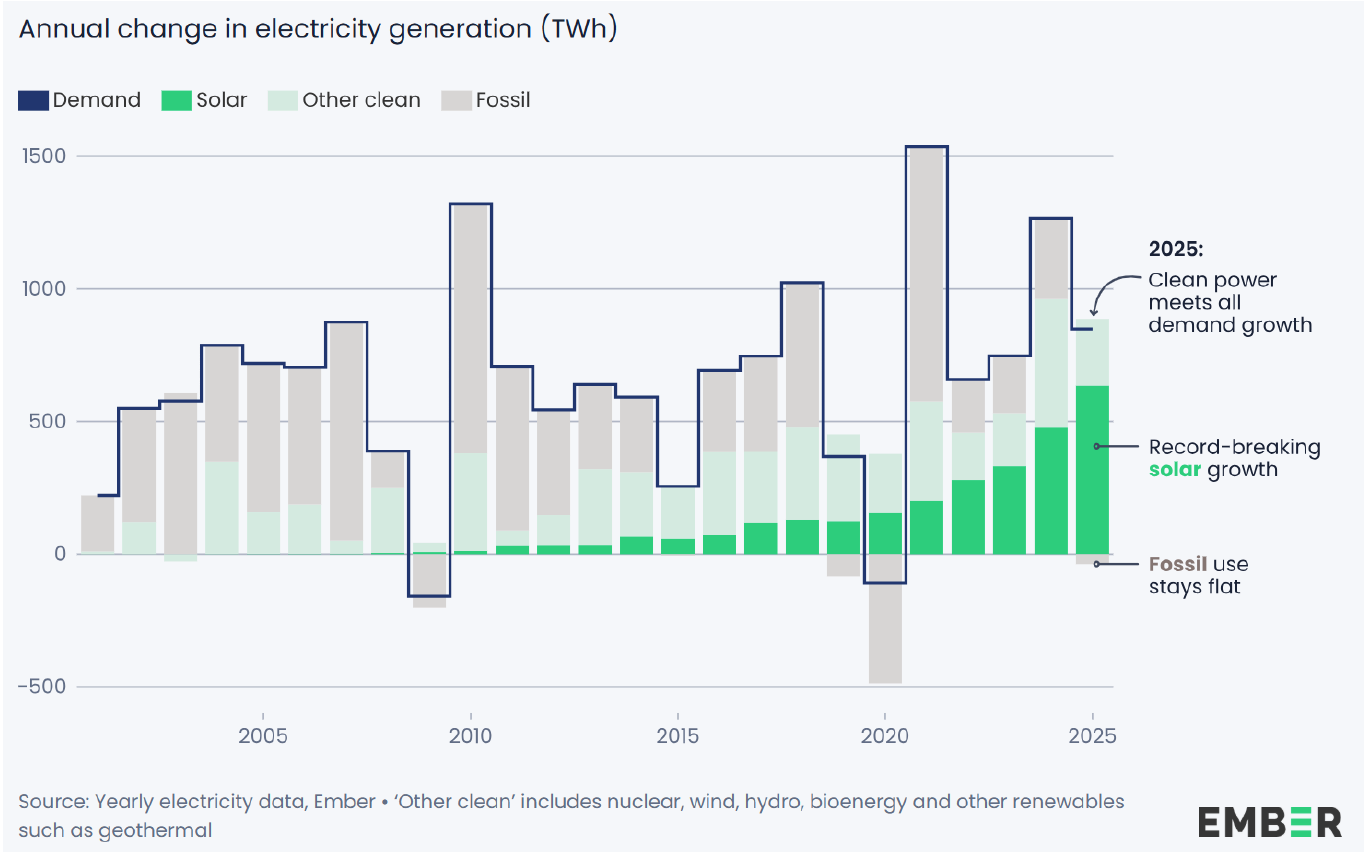
In 2025, low-carbon electricity generation grew by 887 TWh, surpassing the 849 TWh rise in global demand and stalling fossil fuel growth. Solar led this shift, meeting 75% of new demand and helping renewables to overtake coal, pushing coal’s share of global generation below one-third for the first time in history. [Ember]
Energy Transition
TotalEnergies reached a Final Investment Decision on a $1.2 billion onshore wind and battery storage project in Kazakhstan, set to supply renewable power to approximately one million people. Developed alongside Kazakhstan’s state energy companies, the project combines 1 GW of wind capacity with 600 MWh of battery storage, progressing Kazakhstan towards its target for 15% renewable electricity by 2030. [Yahoo! Finance]
British engineering firm Rolls-Royce secured $760 million from the UK National Wealth Fund to accelerate the deployment of the country’s first fleet of small modular reactors (SMRs), with each reactor expected to generate 470 megawatts of low-carbon electricity. This capital supports immediate construction work on factory-built nuclear units as well as the redevelopment of Wylfa, a Welsh nuclear power site that ceased operations in 2015. [Yahoo! News]
Space-based solar energy startup Overview Energy signed a capacity reservation agreement with Meta for up to 1 GW of orbital solar power, targeting a pilot satellite launch by January 2028 and full commercial operations by 2030. The technology will use a fleet of 1,000 satellites to beam near-infrared light from space to existing solar farms, allowing terrestrial solar assets to generate power around the clock without requiring energy storage. [Tech Crunch]
Green Mobility and Sustainable Fuels
Green fertilizer developer Atome greenlit the construction of its $650 million facility in Paraguay, set to produce 260,000 tons of zero carbon ammonia annually from 2029 onwards. The plant will use hydropower from the nearby Itaipu dam to produce green hydrogen via electrolysis, aiming to reduce Latin American import-dependency on fossil fuel-based fertilizers. [Bloomberg]
Germany announced a $235 million investment advancing green mobility in Brazil, as part of a larger $825 million bilateral partnership to promote decarbonization efforts in Brazil. Specific projects within the partnership include electrifying public buses across urban hubs, bolstering biofuel output, and partnering with the private sector to advance green hydrogen in shipping and aviation. [Reuters]
UK-based Clean Planet Technologies opened a world-first pilot facility to convert plastic waste into SAF, achieving a lifecycle greenhouse gas reduction of more than 70% compared to traditional jet fuel. The technology uses heat to break down plastic waste into a synthetic oil that is then refined into high-grade aviation fuel, with Clean Planet aiming to commercially deploy the technology by 2029. [BBC]
Sustainable Materials & Products
US Steel announced a $1.9 billion investment to build a direct reduced iron (DRI) facility in Arkansas, a project set to reduce carbon dioxide emissions by 50% compared to conventional coal-blast furnaces. The plant is the first DRI facility in the US to be situated alongside an existing electric arc furnace, improving energy efficiency through directly blending iron output with recycled scrap metal produced onsite. [Canary Media]
Carbon Direct partnered with Arca to scale their industrial mineralization technology, which accelerates natural chemical reactions to store carbon in industrial alkaline rock waste. Following technology validation during an 18-month trial, Arca is now deploying their process into existing mining operations, helping to tackle the mining sector’s 3 billion tons of annual industrial waste. [Carbon Herald]
The Bezos Earth Fund, a $10 billion philanthropic commitment to scale climate and nature solutions by 2030, announced grant funding for universities working to develop and scale fossil-based textile alternatives including animal-free silk, gene-edited cotton, and bacteria-grown fibers. The fund distributed $34 million in grants to research labs at Clemson University, Columbia University, and the University of California Berkeley, marking its first entry into the sustainable materials sector. [WSJ]
Notable Corporate Commitments
PepsiCo announced a 10-year virtual power purchase agreement alongside Swiss ingredients manufacturer Givaudan and global packaging firm Smurfit Westrock to finance the repowering of a Spanish windfarm operated by Norway’s Statkraft. This project expands PepsiCo’s ongoing pep+ REnew decarbonization program into Europe, utilizing an aggregated demand model to reduce annual supply chain emissions by 32,000 metric tons. [Yahoo! Finance]
Levi Strauss & Co. launched a regenerative agriculture initiative in Pakistan to restore 10,000 hectares of cotton-growing land and plant 100,000 trees for carbon dioxide sequestration over three years. The program aims to improve soil health and water productivity, working to restore ecosystems that provide 30% of Levi’s primary raw materials while mitigating climate-driven production volatility. [WWD]
Global Climate Commitments and Progress
France unveiled a fossil fuel phase-out plan at the First Conference on Transitioning Away from Fossil Fuels in Colombia, aiming to exit coal by 2030, oil by 2045, and natural gas by 2050. The plan is the first fossil fuel exit plan by a major economy and will require displacing 50% of current primary energy consumption with renewable and nuclear generation over the next 25 years. [Bloomberg]
Portugal announced a $26.5 billion investment program to be deployed over the next nine years, prioritizing infrastructure resilience against extreme weather and the modernization of national power systems. The Portuguese government earmarked approximately $4.7 billion for energy storage, hydroelectric dams, and grid upgrades, and will draw additional funding from the EU and private sector investors. [Reuters]
Multimedia Insights
This installment of energy podcast Volts introduces Mike Silvestrini, co-founder of Energea, to discuss how his platform allows ordinary individuals to invest directly in renewable energy projects, with buy-ins as low as $100. Energea invests on the hypothesis that the highest solar returns are in regions with abundant sun but scarce capital, with its projects in rural Brazil, South Africa, and Colombia generating returns while addressing energy poverty with clean power supply.
This episode of Harvard Business School’s Climate Rising podcast explores how climate risk is restructuring financial decision-making across real estate, insurance, and investments. The episode interviews Ed Kearns, Chief Science Officer at climate risk analytics platform First Street, to discuss the role of risk intelligence across flooding, wildfires, and extreme weather in shaping climate adaptation decisions in both public policy and private markets.
Climate Events
Dates: May 20-22, 2026
Location: Singapore
Preview: Innovate4Climate (I4C) brings together governments, the private sector, and market leaders for a discussion on advancing high-integrity carbon markets. This year’s I4C focuses on bridging carbon market policy with practical implementation through a marketplace connecting investors and solution providers.
Dates: June 23-25, 2026
Location: San Francisco, USA
Preview: Trellis Impact focuses on scaling and developing solutions to climate challenges across supply chain decarbonization, meeting AI-driven energy demand, and building circular economies. The conference will bring together innovators and investors through panels, workshops, and a dedicated startup day.
Thank you for reading the Rise Climate Insight Digest. We will be on a brief spring hiatus until June 18th 2026.
This material is solely for informational purposes and shall not constitute an offer to sell or the solicitation to buy securities. The views expressed herein are those of the third-party sources and not necessarily those of TPG.