Chart of the Week
World installed record solar and wind capacity in 2025
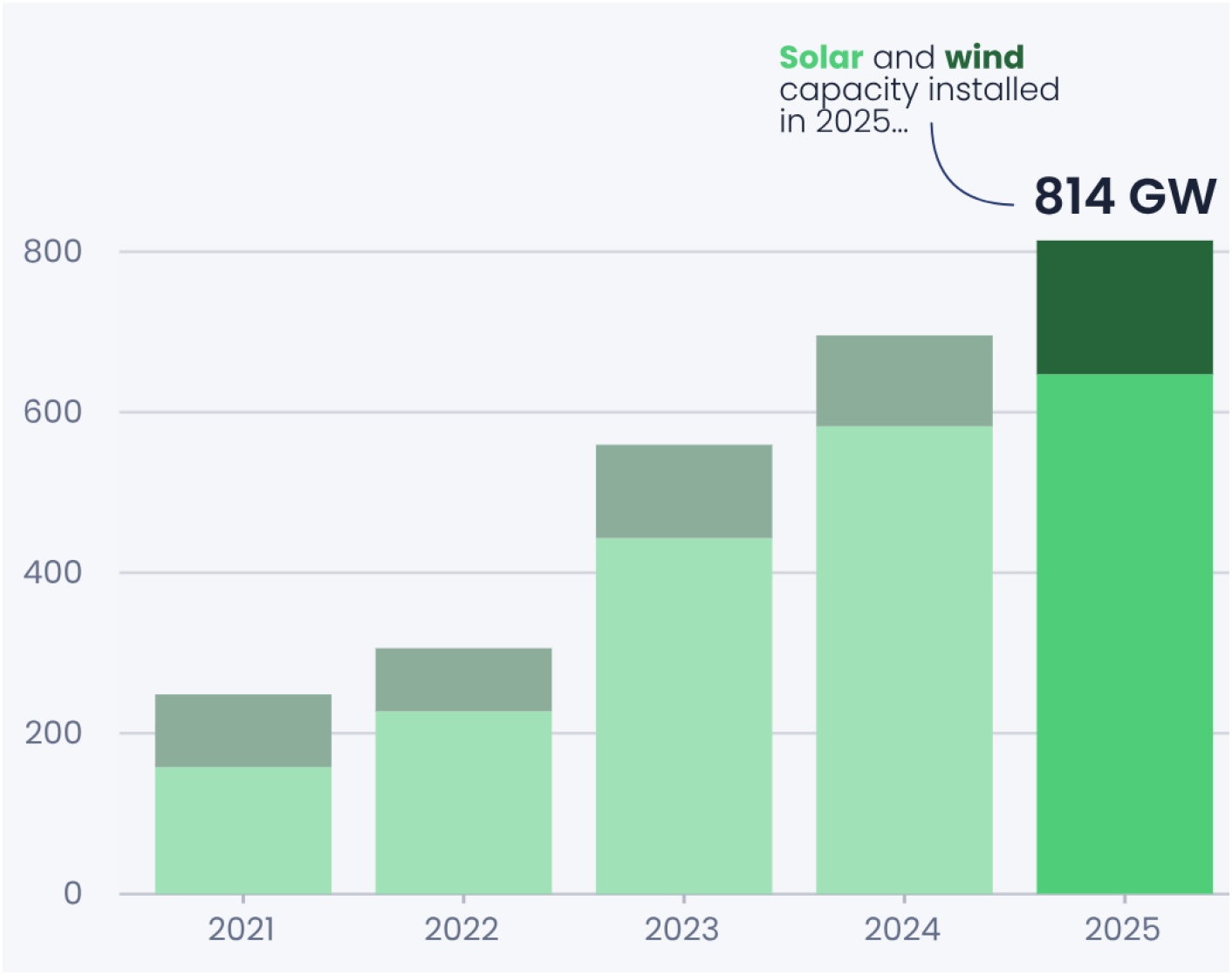
Global solar and wind installations reached a record 814 gigawatts in 2025, a 17% year-over-year increase, bringing total capacity to over 4.17 terawatts. Analysis from energy think tank Ember reported that 2025 capacity additions alone could displace 15% of global natural gas supply, enough to save approximately $138 billion in annual fuel import costs. [Ember]
Energy Transition
The UK government launched a $3 billion Fusion Strategy, establishing the first national framework designed to commercialize fusion energy, a potentially near-limitless clean energy source harnessing the same high-energy nuclear reactions that power the sun. The plan includes a $255 million contract to build a prototype power plant beginning in 2030, with the government targeting the creation of 10,000 jobs in the fusion sector over the next 5 years. [Yahoo! Finance]
The US Department of Energy (DOE) announced $171.5 million in funding to scale geothermal energy and unlock a portion of the US’s estimated 300 gigawatts of untapped geothermal capacity. The funding will support exploration and field tests, aiming to spur private investment into a renewable energy source that provides enhanced grid stability through continuous thermal power. [Forbes]
Nuclear startup TerraPower secured Nuclear Regulatory Commission (NRC) approval to construct a 345 megawatt sodium-cooled reactor in Wyoming. The approval follows TerraPower’s $650 million fundraising round in June 2025. This brings the company’s total capital raised to $1.7 billion, a signal that investors see nuclear startups as an option to provide reliable baseload power for surging tech energy demand. [TechCrunch]
Green Mobility and Sustainable Fuels
Indian-based energy giant Reliance Industries signed a $3 billion green ammonia offtake agreement with a Samsung subsidiary, with the ammonia slated for use in power generation, shipping, and fertilizers. Green ammonia is produced by combining nitrogen with green hydrogen, and Reliance claims the 15-year agreement, beginning 2029, is among the world’s largest green ammonia offtake deals to date. [Reuters]
Renewable fuel developer Southern Energy Renewables announced a $1.4 billion investment to construct a Louisiana plant supplying SAF and green methanol to global markets from 2029. The facility leverages Louisiana’s abundant wood-waste biomass as a feedstock, with the plant targeting carbon negative fuels through integrated carbon capture and sequestration during biomass combustion. [Morningstar]
Rolls-Royce SMR and nuclear developer Equilibrion launched a joint assessment exploring nuclear-powered SAF technology, targeting the production of 160 million liters of SAF per reactor annually. At scale, a single facility could meet one-third of the UK’s 2040 SAF mandate by leveraging consistent nuclear power to bypass renewable energy constraints limiting SAF capacity. [ESG News]
Sustainable Materials & Products
US-based critical metals refining startup Nth Cycle signed a $1.1 billion 10-year offtake agreement with commodity trader Trafigura to supply recycled nickel and lithium carbonate derived from battery scrap. Nth Cycle currently processes 3,100 tons of battery scrap annually in Ohio and is planning to quadruple this quantity through new plants in South Carolina and the Netherlands that will supply recycled materials to Trafigura starting in 2028. [Reuters]
Singapore’s National Environment Agency announced a nationwide beverage container return scheme expected to divert one billion containers, totaling 16,000 tons of waste from incineration annually. The program will launch April 1st with 1,000 reverse vending machine collection points, set to expand to 2,000 in the coming year. These machines will provide a $0.08 refund per container input. [Bloomberg]
Global retailers including H&M, Walmart, and Patagonia signed offtake agreements totaling over $60 million with Rubi, a biotechnology startup using the cellulose found in plant cell walls to create natural clothing fibers. Rubi is undergoing pilot production, using enzymes to transform carbon dioxide from industrial processes waste into natural clothing fibers replacing emissive and non-degradable materials. [TechCrunch]
Notable Corporate Commitments
Tapestry—the parent company of luxury brands Coach and Kate Spade—signed a 10-year carbon removal agreement with carbon removal leader Climeworks, signaling the first entry of a North American fashion retailer into high-quality engineered removals. The partnership utilizes five distinct removal pathways, including direct air capture and renewable electricity generation with permanent carbon dioxide storage, to address Tapestry’s Scope 1 emissions. [Vogue]
The LEGO group announced sustainability plans for its new $1.4 billion US manufacturing facility, which includes the installation of over 30,000 solar panels and the construction of office spaces using mass timber, a renewable resource sequestering carbon. The Virginia facility will be LEGO’s first manufacturing site in the US, with the company aiming to meet 100% of the facility’s energy needs with renewable power. [ESG Today]
Global Climate Commitments and Progress
A report from India’s Central Electricity Authority (CEA) expects solar output to quadruple and wind output to triple, bringing non-fossil power capacity to 786 gigawatts by 2036. This growth in renewable output is projected to reduce India’s dependence on coal as a primary source of electricity generation to 49%, down from 70% currently. [Reuters]
Australia’s second largest coal producing state, New South Wales, banned all applications for new coal mine sites and imposed heightened methane regulations on existing plants. The coal sector is the state’s largest exporter and employs 26,000 residents, prompting the government to announce an investment and training program to help transition coal workers into new careers alongside the ban. [Bloomberg]
Multimedia Insights
This installment of Bloomberg’s Switched On podcast unpacks a recent primer, “Mega Funds to Megawatts”, discussing the growing role of private markets in shaping energy transition strategies. With billions committed but not yet deployed, the episode explores how private capital is likely to shape the geographies and sectors dominating the next stage of the energy transition.
This episode of the Inevitable podcast spotlights Rune, a startup building micro behind-the-meter data centers that bypass the grid to receive power directly from solar and wind farms. With solar clipping and curtailment stranding large quantities of renewable power, Rune converts the unused power into compute capacity for their fully electric network of modular data centers.
Climate Events
Dates: April 8-9 2026
Location: Washington DC, USA
Preview: ClimateTech Connect will convene tech innovators and industry experts for a discussion on advancing climate adaptation and resilience through innovative climate tech solutions. The conference targets adaptation strategies in the re/insurance, financial services, real estate, and public sectors.
Dates: April 8-15 2026
Location: Los Angeles, California, 2026
Preview: For the week of April 8th, Los Angeles will host a variety of climate and sustainability events. This year’s schedule includes workshops on wildfire resilience, climate film festivals, clean tech conferences, as well as hikes and conservation volunteering opportunities.
This material is solely for informational purposes and shall not constitute an offer to sell or the solicitation to buy securities. The views expressed herein are those of the third-party sources and not necessarily those of TPG.