Chart of the Week
Clean energy dominates plans for new US power plants this year
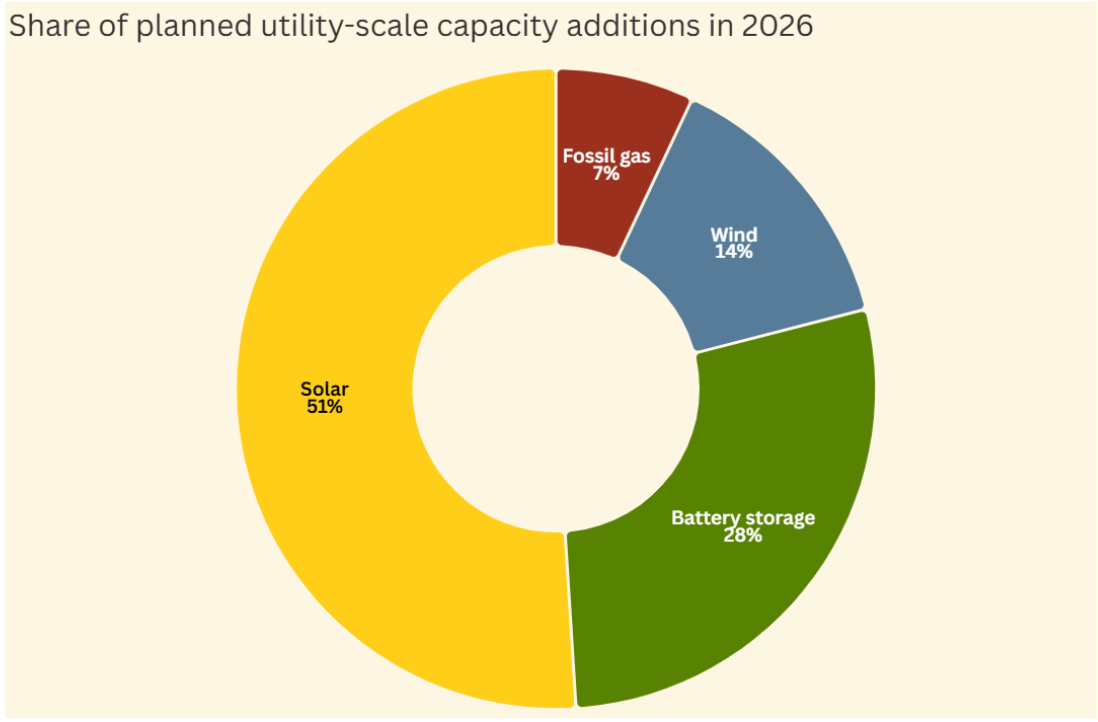
US energy developers are set to add a record 80 gigawatts of utility-scale solar, wind, and battery storage capacity in 2026—if fully realized, these additions will drive the largest annual increase in power capacity in US history. This year’s anticipated capacity additions follow a 2025 build-out of 53 gigawatts that was already the largest in over two decades, signaling an acceleration in power supply deployment.[Canary Media]
Energy Transition
Octopus Australia—the regional subsidiary of the UK energy provider—unveiled a $14 billion investment toward wind and battery storage projects across Australia through 2031. The investment plan directs 60% of capital toward wind assets and the remainder toward batteries and solar-plus-storage, expanding utility-scale infrastructure across New South Wales, Victoria, and Queensland. [Bloomberg | Subscription]
The European Investment Bank (EIB) committed $1 billion to financing renewable energy projects in Sub-Saharan Africa in support of "Mission 300", a World Bank and African Development Bank initiative to provide reliable electricity for 300 million people by 2030. This initial investment marks 50% of total capital mobilization towards EIB’s strategy to deploy $2 billion towards clean energy in Africa by 2027, targeting solar, wind, and hydropower while leveraging partnerships to de-risk private capital mobilization across the continent. [EIB]
Offshore wind developer Aikido Technologies announced a prototype floating offshore wind turbine that houses data centers within the turbine’s underwater tanks, integrating clean power for data center infrastructure while bypassing land and power grid constraints. Scheduled for a 2026 pilot in the Norwegian North Sea, the platform will utilize natural ocean cooling to support 18 megawatts of compute capacity, establishing a scalable blueprint for carbon free data infrastructure. [IEEE]
Green Mobility and Sustainable Fuels
Spanish energy firm Moeve finalized a $1.2 billion investment for a 300 megawatt green hydrogen plant aiming to scale sustainable fuel production in Southern Europe. The project, supported by $360 million in European Union subsidies, marks the first phase of a planned “Green Hydrogen Valley” with 2 gigawatts of electrolyzer capacity in Andalusia, Southern Spain. [Financial Times | Subscription]
Houston-based technology developer Syzygy Plasmonics signed four agreements across the Americas to produce up to 1 million tons of SAF annually by 2035, a volume equivalent to half of total current global SAF production. Syzygy’s process uses renewably powered LEDs to stimulate light-driven chemical reactions that convert biogas into low-emission jet fuel, avoiding the need for emissive and costly combustion processes. [Bloomberg | Subscription]
The European Commission approved the Spanish government’s plan to deploy $200 million towards expanding manufacturing capacity across the Electric Vehicle (EV) value chain, with the funding set to be deployed by June 2026. The Spanish government will provide direct grants to support the production of energy storage and hydrogen technologies necessary for EV manufacturing, alongside incentivizing the reuse of critical raw materials to promote a circular economy for EV components. [European Commission]
Sustainable Materials & Products
German building materials leader Heidelberg Materials and Ghanaian industrial firm CBI Ghana commissioned a $110 million facility in Tema, Ghana establishing the world’s largest plant for calcined clay, a low-carbon substitute for conventional cement clinker. Once fully operational, the facility will produce 1.5 million tons of cement annually, utilizing locally sourced clay to reduce Ghanian import reliance on emissive clinker by 10%. [MSN]
Tata Steel partnered with Germany energy startup Kraftblock to deploy a 20 megawatt hour thermal storage system, set to reduce annual emissions by 22,000 metric tons per year at Tata Steel’s mill in Eastern India. The heat battery stores waste heat from the early stages of the steelmaking process then repurposes that heat to power the plant, a process that is set to replace 110 gigawatt hours of annual fossil gas consumption. [Canary Media]
L’Oréal signed a multi-year offtake agreement with Dioxycle to supply sustainable plastic feedstock derived from captured carbon, creating a drop-in replacement in low-carbon packaging and textiles. As a substitute for the world’s most widely consumed organic chemical, ethylene, Dioxycle’s product supports L’Oréal’s target to reduce virgin plastic use by 50% by 2030. [ESG Today]
Notable Corporate Commitments
Seven companies—including Amazon, Google, Salesforce, and J.P. Morgan— launched a $100 million initiative aiming to reduce emissions from superpollutants such as methane, soot, and refrigerants. The companies will fund high-integrity projects aimed at curbing superpollutants, where emissions impacts are elevated due to the elevated global warming potential of superpollutants relative to carbon dioxide. [Trellis]
Mars launched an $85 million fund to enhance climate resilience across its global agricultural supply chains through 2027, establishing a vehicle that will deploy at least $50 million annually beginning in 2028. The initiative prioritizes multi-year investments to improve the adaptive capacity of sourcing communities for ingredients like cocoa and mint, addressing physical climate risks that threaten long-term raw material security. [Forbes]
Global Climate Commitments and Progress
Algeria committed $1 billion to construct three desalination plants that will provide 900,000 cubic meters of daily water capacity, improving the resilience of Algeria’s agriculture to escalating climate- induced drought. The Algerian Desalination Co., a state-owned utility, leads the projects as part of a $5.4 billion strategy to meet 60% of national water demand through desalination by 2030 and reclaim 4 billion cubic meters of freshwater annually for food production. [Bloomberg | Subscription]
Chinese government agencies launched a strategic framework to industrialize solar module recycling with a target to process 250,000 tons of retired equipment by 2027. The policy incentivizes manufacturers to integrate recycled components into new modules to manage an estimated 1.5 million tons of cumulative waste by 2030 and bolster the circularity of the global solar supply chain. [Bloomberg | Subscription]
Multimedia Insights
This installment of the Environmental Law Institute’s People, Places, Planet podcast discussed the emerging role of the private sector in environmental law. The conversation highlighted supply chain management, public-private partnerships, and large-scale capital deployment as influential private sector tools in environmental governance.
This episode of theInevitable podcast highlights Stu Landesberg, Co-founder and CEO of Seneca, a startup developing autonomous systems to detect and suppress wildfires in the American west before they grow out of control. Seneca underscores the role of climate tech and innovation in meeting climate adaptation needs through early detection and intervention.
Climate Events
Summit Dates: March 24-25 2026
Location: Amsterdam, The Netherlands
Preview: The Future of Energy summit will bring together investors, project developers, and financial institutions for two days of conversation on accelerating the energy transition in emerging markets.
First Conference on Transitioning Away from Fossil Fuels
Dates: April 24-29 2026
Location: Santa Marta, Colombia
Preview: Established by the governments of Colombia and the Netherlands at COP30, this conference aims to convene countries, subnational governments, and stakeholders for an implementation-focused conference on the transition away from fossil fuels. The conference will focus on implementing the energy transition through advancing cooperation, incentivizing clean investment, and overcoming fossil-fuel economic dependence.
This material is solely for informational purposes and shall not constitute an offer to sell or the solicitation to buy securities. The views expressed herein are those of the third-party sources and not necessarily those of TPG.