Chart of the Week
US solar energy generation outpaces coal for the first time in history
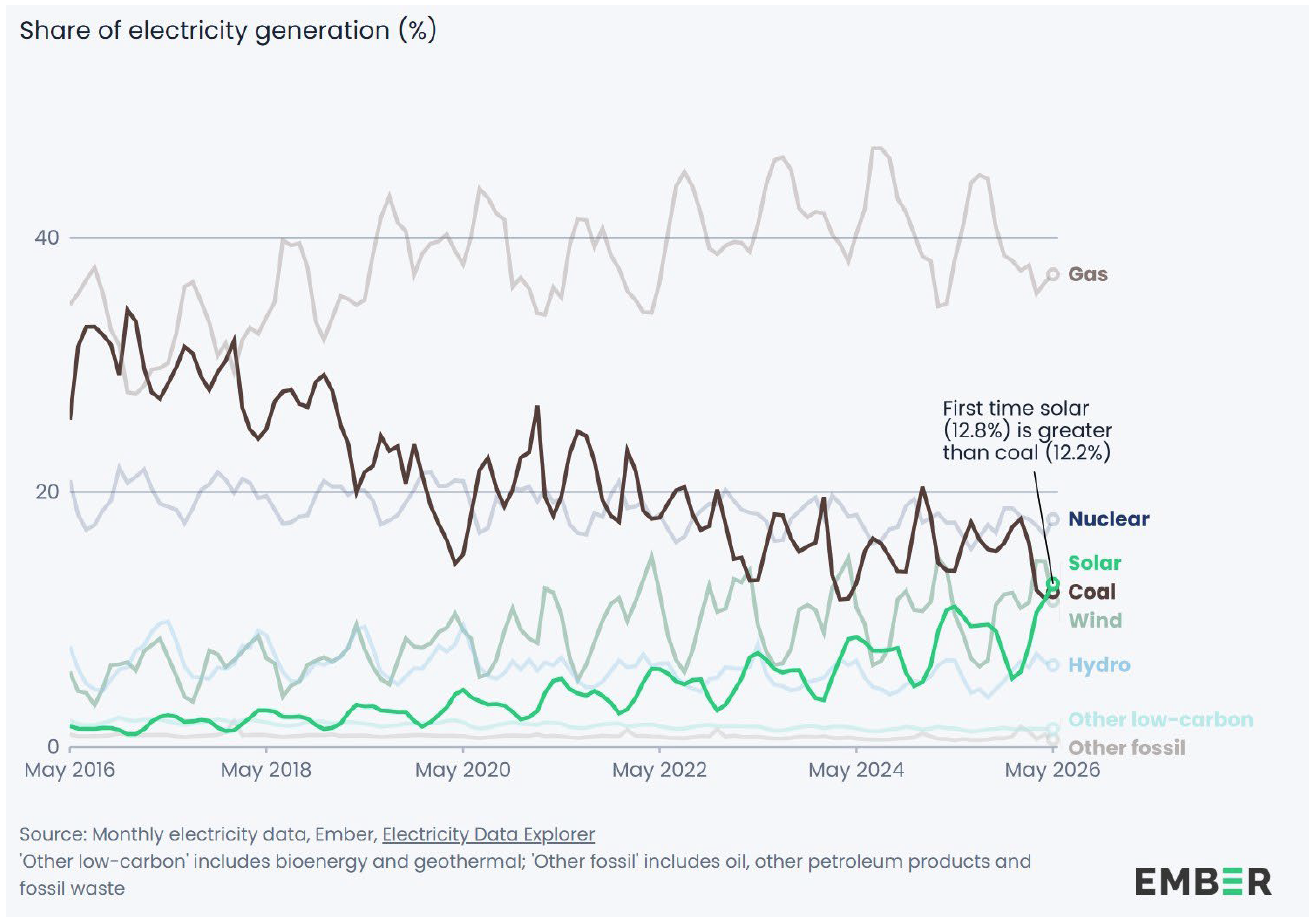
US solar generation reached a record 45.5 terawatt-hours in May 2026, surpassing coal in the electricity mix for the first time ever. Over the past five years, solar’s share of US electricity generation rose from about 5 percent to 13 percent, while coal’s share fell from about 20 percent to 12 percent. [Ember]
Energy Transition
Spanish engineering firm Lointek announced plans for a 50-megawatt liquid air energy storage (LAES) facility in the UK, providing 300 megawatt-hours of long-duration capacity to the grid by 2027. The project, which is the largest of its kind, was developed for the UK-based energy infrastructure company Highview Power and extends the storage life of renewable energy by cooling air into a liquid state. [PV Magazine]
Chinese battery manufacturer CATL launched the world’s largest energy storage testing facility, investing $441 million to assess how battery systems function under real-world conditions. The institute, which contains the first-ever electromagnetic compatibility laboratory capable of evaluating 40-foot battery containers under charging and discharging operations, aims to generate verified battery performance data. [MSN]
Meta signed new power purchase agreements (PPAs) with renewable energy producer DESRI for 850 megawatts of capacity from solar and battery storage projects across the US. Located in Oklahoma, Texas, and Mississippi, the projects bring DESRI and Meta’s contracted total to 2,575 megawatts, 1,110 megawatts of which will begin construction in 2026. [PR Newswire]
Green Mobility & Sustainable Fuels
Waymo revealed plans to reuse thousands of old electric vehicle batteries for renewable energy storage in partnership with clean power start-up B2U Storage Systems. The batteries will help support the strained grids in Waymo’s key service markets, California and Texas, generating an estimated $8,000–$10,000 in value per battery. [ESG Investing]
Researchers at Pennsylvania State University developed a new, high-efficiency reactor that uses microbes to convert carbon dioxide and renewable energy into methane, providing a new way to store energy long term. The reactor uses excess electricity to split water into hydrogen, which microbes utilize to convert carbon dioxide into methane, employing a “zero-gap” design that reduces electrical resistance. [Tech Xplore]
Mexican electric vehicle start-up Olinia unveiled its new $8,600 low-speed passenger electric vehicle prototype. Designed for affordability, the six-seater cargo model is expected to cost less than half as much per mile as a motorcycle and about one-fifth as much as a conventional sedan. [Inside EVs]
Sustainable Materials & Products
AstraZeneca, climate tech platform Secaro, and sustainability consultancy ERM launched the Clean Heat Program to decarbonize industrial heating processes that account for ~18 percent of global greenhouse gases. The initiative uses data tools to analyze thermal energy requirements across supplier networks, identify low-carbon technology alternatives, and establish strategic transition frameworks for companies pursuing energy transitions. [ESG News]
British-Australian mining firm Rio Tinto announced a $1.5 billion investment to expand its low-carbon aluminum smelter in Quebec, adding 160,000 metric tons of annual production capacity by the end of 2026. The project utilizes high-efficiency technology powered by hydroelectricity to reduce greenhouse gas production to ~2 tons of carbon dioxide equivalent per ton of aluminum, 85% less than the industry average. [Yahoo! Finance]
University of Pennsylvania developed a circular manufacturing process that transforms food waste into structural building materials to address a waste stream responsible for ~8 percent of global greenhouse gases. The technology converts powdered organic scraps into durable, cement-like construction material by using shrimp shells as a binding agent. [WHYY News]
Notable Corporate Commitments
Samsung Electronics executed Vietnam’s first grid Direct Power Purchase Agreement (DPPA) to procure 70 gigawatt-hours of solar energy annually for its local manufacturing operations beginning in June. The agreement utilizes a new regulatory framework that allows corporations with facilities using more than 200,000 kilowatt-hours per month on average to purchase power directly from renewable energy developers, creating a model for large-scale industrial decarbonization in the country. [Tech Times]
Pan-African lender Ecobank launched a $450 million nature bond to fund sustainable agriculture, water management, and biodiversity conservation across 24 African countries, attracting more than $1.36 billion in demand. The deal is the world’s first ICMA-aligned nature bond issued by a commercial bank and could help draw more global nature investment to Africa, which is home to 25 percent of the world’s biodiversity. [ESG Today]
Global Climate Commitments and Progress
The UK set a legally binding emissions cap of 535 million metric tons of carbon dioxide equivalent for 2038–2040, representing an 87 percent reduction in greenhouse gas emissions from 1990 levels. The country plans to invest in clean,energy technology and expand low-carbon solutions by offering heat pump,installation grants. [Reuters]
Rwanda increased its emissions reduction target to 53 percent of the 4.4 million tons of greenhouse gas emissions it is expected to produce by 2030 if no action is taken, despite a $6.2 billion climate finance gap. The country has already cut 1.5 million tons of carbon emissions ahead of schedule, achieving 36 percent of its 2030 reduction target under the Paris Agreement. [The New Times]
Multimedia Insights
Y Analytics Webinar 3 | New Themes: Adaptation and Resilience
Y Analytics and TPG Rise Climate are pleased to announce the release of the final installment in our webinar series highlighting Y Analytics’ impact assessment methodologies and research approaches. This session features Judith Rodin, TPG Y Analytics Editorial Advisory Board Member and President Emerita of the University of Pennsylvania and explores emerging themes in adaptation and resilience.
The webinar is available here (password: YAnalytics@2026) and in the flyer attached in this digest.
This installment of The Climate Question, hosted by BBC, discusses Southeast Asia, the fastest-growing electric vehicle market worldwide. Reporters from Ember and Bloomberg explore how the green mobility boom creates new jobs in the energy sector, impacts the climate, and reduces carbon emissions in countries like Vietnam and Thailand.
Climate Events
Dates: June 20–28, 2026
Location: London, United Kingdom
Preview: London Climate Action Week brings together over 75,000 people for one of the largest independent climate events worldwide. The gathering will feature over 750 events across nine days on topics ranging from finance to philanthropy.
Hamburg Sustainability Conference
Dates: June 29–30, 2026
Location: Hamburg, Germany
Preview: The Hamburg Sustainability Conference aims to accelerate the adoption of UN sustainable development goals ahead of the 2030 deadline by bringing together a wide range of leaders and stakeholders in the climate space. The event will focus on building resilient economies through investments in climate technology, navigating global crises, and fostering international collaboration.
This material is solely for informational purposes and shall not constitute an offer to sell or the solicitation to buy securities. The views expressed herein are those of the third-party sources and not necessarily those of TPG.