Chart of the Week
Gap between Q1 heat pump and conventional AC sales shrinks to a record low in the US
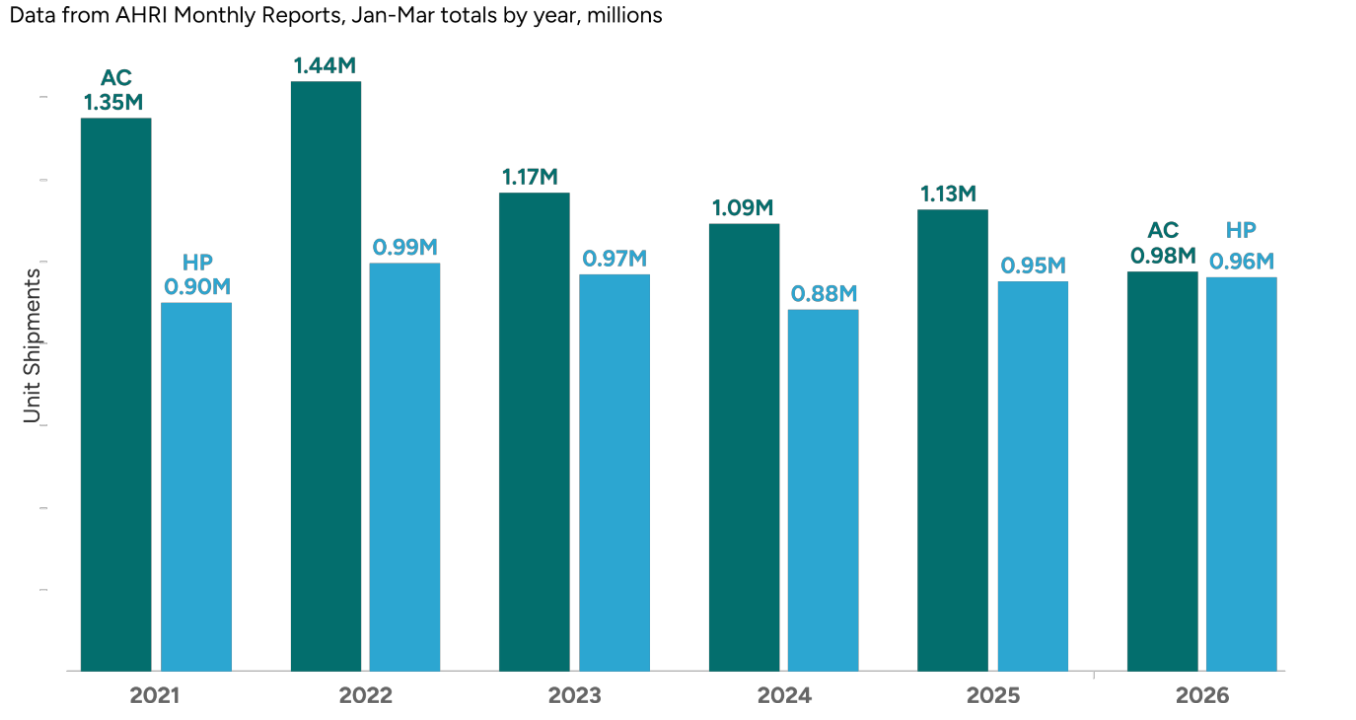
The gap between US traditional air conditioner and heat pump sales narrowed from 16% in Q1 2025 to 2% in Q1 2026, signaling continued demand for heat pumps despite the repeal of federal tax incentives and waning consumer interest in new AC units. Heat pumps, which are two to four times more efficient than fossil-fueled alternatives, offer a scalable zero- emissions solution for residential heating and cooling needs. [Building Decarbonization Coalition]
Energy Transition
Chinese energy tech firm Sigenergy secured strategic agreements to deploy over 20 gigawatt hours of energy storage capacity across Europe, Africa, and the Asia-Pacific region. The firm’s solar solutions, which range from household heat pumps to PV inverters, utilize a proprietary artificial intelligence agent to automate energy management for residential and industrial applications. [Business Insider]
UAE-based clean energy leader Masdar secured a $5.1 billion investment to develop a 5.2 gigawatt solar plant with 19 gigawatt hours of onsite battery energy storage in Abu Dhabi, which is set to be the world’s first round-the- clock renewable energy project. The facility will combine a high-capacity PV array with the world’s largest battery energy storage system to supply continuous carbon-free power to data centers and advanced manufacturing projects beginning in 2027. [Power Technology]
Singapore-based renewable energy developer Vena Energy secured $970 million to accelerate the deployment of more than 600 megawatts of solar and 1 gigawatt hour of battery storage projects across Australia. The financing will support 294 megawatts of existing solar capacity and 320 megawatts of new solar projects, helping avoid an estimated ~1 million tons of carbon dioxide emissions and ~900 million liters of water use each year compared with non-renewable energy generation sources. [Renew Economy]
Green Mobility & Sustainable Fuels
Global vehicle manufacturer Daimler Truck and Munich-based engine technology firm KEYOU announced a partnership to commercialize hydrogen- powered internal combustion engines for heavy-duty freight, with the first batch of 40-ton trucks slated for market launch by 2027. The collaboration will refit existing truck models to expand reduced emission options for payload-intensive vehicles. [ESG Today]
230 US electric vehicle-to-grid (V2G) school buses, capable of powering up to 1,600 US homes for 4 hours at a time, helped ease grid strain across 21 states during a record heat wave. The buses, part of different pilot projects around the US, are equipped with bidirectional charging units that can send excess energy from their batteries back to the grid during peak demand. [Electrek]
Deutsche Bank collaborated with Lufthansa Group to fund the deployment of over 1,700 tons of SAF, reducing carbon emissions by an estimated 6,000 tons. The investment is part of Deutsche Bank’s broader plan to reduce Scope 3 emissions by 50% compared with a 2019 baseline by 2030. [ESG Dive]
Sustainable Materials & Products
Dutch carbon removal startup Paebbl launched the world’s first Environmental Product Declaration-certified carbon-negative construction material. The proprietary mineralization process captures and converts atmospheric carbon into stable minerals for use in concrete, sequestering 149 kilograms of carbon dioxide per ton of concrete and allowing large-scale infrastructure projects to function as permanent carbon storage sites. [Carbon Herald]
Japanese drink company Suntory Beverage & Food announced a $73 million climate plan to both cut Scope 3 emissions and protect its 10,500-ton annual blackcurrant fruit supply from rising temperatures by 2027. The investment will fund the development of heat-tolerant crop varieties, ensuring long-term ingredient security and agricultural stability for Suntory’s beverage portfolio. [Net Zero Compare]
The Spanish government allocated ~$364 million to cement producers Votorantim Cimentos España and Cemex España to scale carbon capture and hydrogen technologies across the nation's industrial sector. The funding will support Votorantim’s efforts to reach an emissions intensity of 475 kilograms of carbon dioxide per ton by 2030 through carbon liquefaction infrastructure as well as enable Cemex to replace fossil fuels with waste-to-hydrogen systems at its Catalonia facility. [World Construction Today]
Notable Corporate Commitments
Amazon signed a long-term agreement to purchase 1.95 million metric tons of carbon removal credits from South Africa’s Spekboom Restoration Project. South African developer Imperative will restore 50,000 hectares of native Spekboom shrubs, sequestering a projected 35 million metric tons of carbon dioxide over 40 years. [Yahoo! Finance]
Siemens and German climate tech firm Ucaneo partnered to scale a first-of- its-kind Direct Air Capture (DAC) facility into one of the largest operational electrochemical DAC plants in the world. The facility, which will be Germany’s first DAC project to store captured emissions within geological formations, can remove up to 165 tons of carbon dioxide annually using an electrochemical process to purify atmospheric carbon. [Renewable Carbon]
Global Climate Commitments and Progress
China announced a national energy plan to generate 50% of its electricity from non-fossil sources and reduce power-sector carbon dioxide emissions intensity by 10% by 2030. This strategy accelerates the country’s existing deployment of 300 gigawatts of non-pumped hydro energy storage and targets 2 million metric tons of annual renewable hydrogen production. [ESG News]
Oman signed agreements with a consortium led by EDF to develop a new 2 gigawatt pumped hydro plant, which is set to become the largest hydro storage facility in the Middle East. The planned Jabal Abyad hydro plant will provide the long-duration energy storage necessary to stabilize the national power system and help the country scale dispatchable renewable power. [Renewables Now]
Singapore initiated a $100 billion climate resilience strategy by commencing the "Long Island" project to reclaim 800 hectares of land and defend the city- state against rising sea levels. This massive adaptation effort integrates a new reservoir and advanced tidal gates to provide flood protection for the nation’s East Coast region, which is currently situated less than five meters above sea level. [Bloomberg(Subscription)]
Multimedia Insights
This episode of Harvard Business School’s Climate Rising podcast discusses how the California-based company Rain uses AI-powered wildfire suppression systems to build autonomous aircraft that can mitigate blazes within a few minutes of ignition. The conversation, featuring Rain’s CEO and co-founder Max Brodie, explores the benefits and challenges of using autonomous technology to prevent wildfires in sensitive ecosystems.
This installment of the Guardian’s Science Weekly podcast goes in-depth on UK-based climate action company Real Ice’s mission to refreeze the Arctic. Led by a team of Arctic scientists and sea ice experts, the company works with the local Inuit community to pump seawater to the frozen ocean surface and has successfully thickened the ice of Canada’s Cambridge Bay by more than 80 centimeters over the past two years.
Climate Events
Location: Stockholm, Sweden
Dates: August 23-27, 2026
Preview: Hosted by the Stockholm International Water Institute (SIWI), the 35th annual World Water Week will align private investment with global water security and climate adaptation targets ahead of the 2026 UN Water Conference. This year’s theme, Water and People, will focus on gender-based inequity in water access and center Indigenous solutions to water management.
2026 Nuclear Energy Conference and Expo
Location: Dallas, Texas
Dates: August 24-27, 2026
Preview: The Nuclear Energy Conference and Expo (NECX) will bring together more than 1,000 industry leaders and innovators to discuss the future of US nuclear deployment. The 2026 program will feature exhibitions from leading energy companies and educational panels focused on advanced reactor development, safe nuclear expansion, and workforce training and retention.
This material is solely for informational purposes and shall not constitute an offer to sell or the solicitation to buy securities. The views expressed herein are those of the third-party sources and not necessarily those of TPG.