Chart of the Week
Clean energy stocks outperformed both the Nasdaq 100 and S&P 500 in 2025.
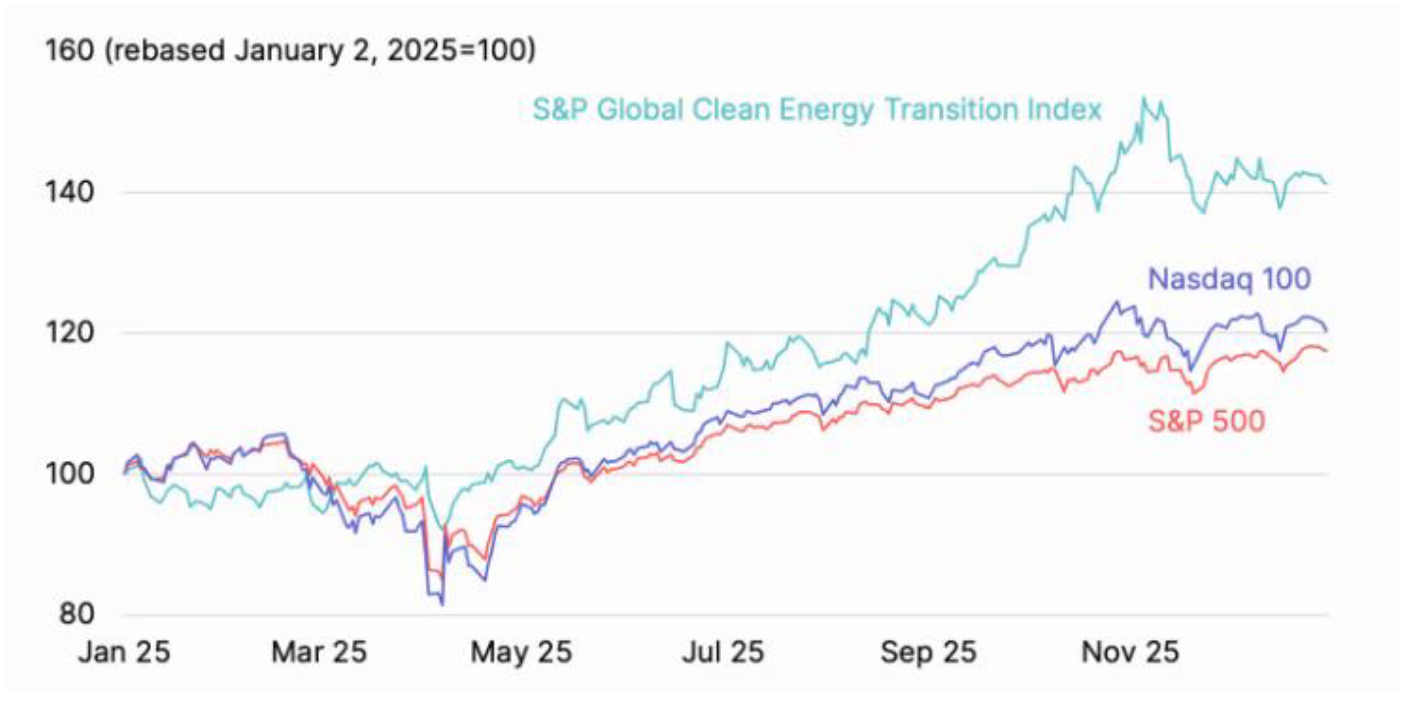
Returns from the S&P Global Clean Energy Transition Index, tracking clean energy producers from advanced and emerging economies, topped both the Nasdaq 100 and S&P 500 for the majority of 2025. At the end of 2025, the Clean Energy Index was outperforming both benchmarks by 20 index points. [Nat Bullard]
Energy Transition
The UK government awarded a record 8.2 gigawatts of conventional (fixed-bottom) offshore wind and 192 megawatts of floating offshore wind Contracts for Difference (CfDs) in Europe’s largest ever offshore wind auction. The deals will bring the UK’s operational offshore wind capacity to 36 gigawatts over the next four years, while supporting billions in private investment and supplying enough electricity to power over 8 million households. [Financial Times]
Egypt signed $1.8 billion in clean energy and manufacturing deals to develop a 1.7 gigawatt solar power and battery storage project in Upper Egypt and a new battery manufacturing facility in the Suez Canal Economic Zone. The deals support Egypt’s target of generating 42% of electricity from renewables by 2030 and include power purchase agreements of nearly 2 gigawatts of solar capacity with 4 gigawatt hours of battery storage. [Reuters]
Vattenfall reached a final investment decision (FID) for a 1.6 gigawatt offshore wind cluster, including the 980 megawatt Nordlicht I set to become Germany’s largest offshore wind farm. The turbines for both wind farms in the cluster will be constructed from low emission steel, which is expected to reduce the turbine tower’s carbon footprint by 16% compared to conventional steel. [Yahoo! Finance]
Green Mobility and Sustainable Fuels
The UK government unveiled a $60 billion long-term rail infrastructure plan for the North of England, including the electrification of rail routes between key regional hubs, with construction set to begin from 2030. Bridging Northern England’s rail infrastructure gap could boost annual GDP by $54 billion through increased productivity, while replacing emissive car journeys with low-carbon rail. [BBC]
Global commodities supplier Trafigura signed a six-year offtake deal to purchase the entirety of the SAF produced at Syzygy Plasmonics’ new Uruguay facility, with deliveries set to begin in 2028. Syzygy’s first commercial facility will combine biogas feedstock with a photoreactor, powering SAF production with renewable powered LED light rather than combustion, together cutting emissions by up to 90% compared to conventional jet fuel. [Carbon Herald]
The California Department of Transportation awarded a total of $202 million to 143 clean public transportation projects across the state through its climate investment initiative, targeting the areas most impacted by air pollution. Selected projects include electric bus procurement in San Diego, support for the expanded Los Angeles metro, and low-income subsidy fares in San Francisco. [CA.gov]
Sustainable Materials & Products
Amazon Web Services partnered with mining giant Rio Tinto to source 14,000 tonnes of Nuton copper, a sustainable alternative which reduces water use by 80% and carbon emissions by 60% compared to conventional copper. Nuton copper is produced using a bio-heap leaching process, where specialized microbes extract copper from ore and mine waste without the need for traditional smelting. [The Wall Street Journal]
The L’Oreal Group selected 13 climate tech startups to receive a combined $117 million in funding over five years through its sustainability accelerator, which aims to promote innovation towards driving circularity in packaging and consumer products. Selected startups include Kelpi, harnessing seaweed for low-carbon packaging, and Novobiom, using fungi to break down complex waste into new high-value products. [Vogue]
Low carbon cement producer Hoffmann Green and French construction group BRIAND expanded their partnership to scale 0% clinker cement across French building projects, eliminating the most energy intensive step of cement production. Following a 30% increase in BRIAND’s low-carbon concrete uptake in 2025, the partnership aims to continue this roll-out across office, residential, and educational buildings. [S&P Global]
Notable Corporate Commitments
Microsoft agreed to purchase two million afforestation, reforestation, and revegetation carbon credits over nine years from Rubicon Carbon, with the credits sourced from independent farmers in Northern Uganda. The reforestation initiative, through Kijani Forestry’s Smallholder Farmer Forestry Project, is projected to boost the household income of smallholder farmers by 600% per acre of trees planted. [Business Wire]
eBAY unveiled its first climate transition plan, outlining steps to reach net-zero emissions across its full value-chain by 2045, building on its 2024 achievement of powering all facilities with 100% renewable power. The climate plan will target initiatives such as local pickup to reduce Scope 3 shipping emissions, which currently account for 84% of eBAY’s emissions. [Reuters]
Global Climate Commitments and Progress
New analysis from think tank Ember Energy highlights that India is bypassing the traditional fossil fuel-heavy industrialization route by leveraging plummeting electrotech costs to scale solar and electric vehicles more rapidly than China did at equivalent income levels. This adoption of electrotech offers India significant structural advantages, including enhanced energy sovereignty and the opportunity to become a global hub for green manufacturing while avoiding the legacy costs of stranded coal assets. [Ember Energy]
The Singapore Economic Development Board launched new blue carbon and biomass initiatives to strengthen high-integrity carbon markets across Asia, partnering with the World Wildlife Fund (WWF) to boost scientific measurement, reporting, and verification. Initiatives include grants for digital tools that quantify forest carbon storage in Southeast Asia, alongside technical support to help developers scale and commercialize high-integrity carbon projects. [ESG News]
Multimedia Insights
This installment of Harvard Business School’s Climate Rising podcast interviews Erik Berglöf, Chief Economist at the Asian Infrastructure Investment Bank (AIIB), on the bank’s work financing nature-based solutions in emerging economies. The episode highlights the growing role of public private partnerships in scaling capital towards integrating nature and conservation into infrastructure development.
This episode of the Inevitable podcast hosts Augustus Doricko, Founder and CEO at Rainmaker, a company aiming to increase rain and snow in the water scarce Western United States using cloud seeding and drone technology. The episode discusses the regulatory and public pressure around weather modification technology, as well as its advantages for ecosystem conservation and agriculture.
Climate Events
Dates: February 17-19 2026
Location: Phoenix, Arizona, USA
Preview: This conference brings together business leaders to share solutions to sustainability challenges, including renewable energy procurement and Scope 3 emission reductions. With speakers across the financial services, fashion, and technology industries, the conference provides an opportunity for collaboration towards shared sustainability goals.
Dates: March 3-5 2026
Location: Cape Town, South Africa
Preview: The Africa Energy Indaba is the continent’s flagship event dedicated to energy, with representation from industry leaders, businesses, and government. The event highlights sustainability efforts through forums on the potential of nuclear energy in Africa, driving EV adoption across the continent, and harnessing the continent’s immense solar potential.
This material is solely for informational purposes and shall not constitute an offer to sell or the solicitation to buy securities. The views expressed herein are those of the third-party sources and not necessarily those of TPG.