Chart of the Week
Wind and solar overtake fossil power in the EU for the first time in 2025
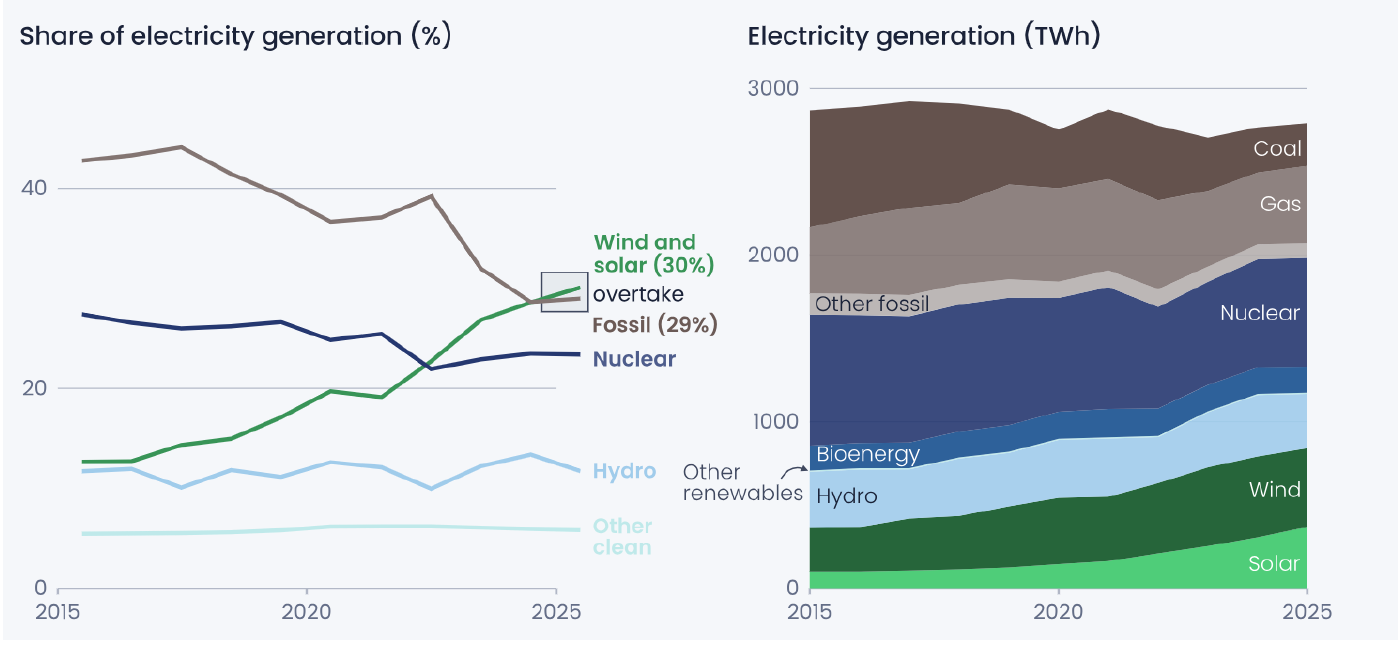
Wind and solar provided 30% of the European Union’s electricity generation in 2025, exceeding fossil fuel-based sources for the first time. 14 of the EU’s 27 member states achieved this bloc-wide milestone of solar and wind electricity exceeding fossil fuels, with an increase in solar generation across all 27 countries driving the shift. [Ember]
Energy Transition
The UK’s latest onshore wind and solar auction secured a record 6.2 gigawatts of capacity, with government Contracts for Difference (CfD) unlocking an estimated $6 billion in private sector investment. The auction achieved record low prices for UK solar installations, with new solar 50% cheaper than new natural gas, and raised total secured capacity to 14.7 gigawatts, set to provide enough power for 16 million British homes. [Reuters]
Octopus Energy Generation—the investment arm of the UK’s largest energy provider—committed $1 billion to California’s energy transition to scale a portfolio of solar-plus-storage, industrial heat batteries, and climate tech. This initial phase of Octopus’ commitment to invest $2 billion in the US by 2030 leverages a new UK-California clean tech partnership, using the state’s favorable regulatory environment to mature climate assets for eventual global deployment. [Electrek]
California-based startup Lunar Energy secured $230 million to expand its home battery operations into Texas, Puerto Rico, and Hawaii, targeting 100,000 annual installations by 2030. The integrated hardware and software platform manages virtual power plants that discharge stored energy during peak demand, providing a solution to grid instability while earning participating homeowners an average of $464 annually. [Bloomberg]
Green Mobility and Sustainable Fuels
London’s Heathrow Airport announced plans to reach 5.6% SAF usage in 2026, a target outpacing the UK government SAF mandate of 3.6%. To accommodate the policy, which could save up to 600,000 tonnes of carbon emissions this year, Heathrow is providing $100 million to airlines to bridge the cost gap between kerosene and SAF. [ESG News]
The $35 billion “Morocco Offer” plan to scale the country’s green ammonia and industrial fuel production advanced as the government finalized land reservations for five major green hydrogen projects in its southern regions. The initiative aims to position the country as a global hub for green shipping and low-carbon fuels, leveraging coastal renewable resources to drive maritime decarbonization. [Morocco World News]
SAF producer SkyNRG secured financing for the Netherlands’ first large-scale SAF facility, entering the construction phase on a plant set to produce 100,000 tonnes of aviation fuel annually from mid-2028. KLM Royal Dutch Airlines is set as the facility’s primary off taker, with the airline reducing its emissions footprint through lifecycle emissions reductions of up to 90% compared to conventional jet fuel. [Carbon Herald]
Sustainable Materials & Products
France committed $2 billion in subsidies over 15 years to decarbonize hard-to-abate sectors including cement and aluminum through carbon capture and electrification. This funding targets an annual reduction of 3.8 million metric tons of carbon dioxide by supporting large-scale decarbonization projects led by industrial majors including Holcim, Heidelberg Materials, and Ineos. [Reuters]
The European Union banned the destruction of unsold apparel, clothing accessories, and footwear, a practice currently accounting for 5.6 million tons of annual European carbon dioxide emissions. With 4-9% of unsold textiles destroyed before first wear, the ban encourages producers to reuse textiles and properly handle returns, coming into effect for large companies in July 2026 and smaller businesses in 2030. [EU Commission]
BMW Group and German environmental services provider PreZero partnered to advance closed-loop recycling to recover and reuse steel, aluminum, plastics, and battery materials from end-of-life vehicles across Europe. The collaboration will trial and scale advanced sorting technologies for serial production, aiming to replace carbon-intensive primary resources with secondary raw materials to meet tightening EU circularity mandates. [Yahoo! Finance]
Notable Corporate Commitments
Microsoft announced that it reached its target to match 100% of global energy consumption with renewable sources through global power purchase agreements, a target the company first set in 2020. Microsoft contracted 40 gigawatts of renewable energy—19 gigawatts currently online and the rest due by 2030—matching current and anticipated energy demand with additional clean energy for the grid, enough to power 10 million homes. [Wall Street Journal]
The NFL and PepsiCo partnered to reduce single-use plastic waste at the Super Bowl LX, expanding a 2025-26 season pilot at Levi’s Stadium that saved 32,000 plastic cups through reusable materials and accessible recycling points. This initiative integrates waste circularity into the league’s broader decarbonization strategy, which includes investments in renewable energy procurement and sustainable transport to events. [Good Morning America]
Global Climate Commitments and Progress
China’s carbon emissions fell by 0.3% in 2025, marking the first decline since pandemic-era restrictions as record renewable generation met all new energy demand growth. While still an early indicator, this plateau in emissions highlights the potential for China, accounting for ~30% of global greenhouse gas emissions, to hit peak emissions ahead of its 2030 target. [Carbon Brief]
India and the UK announced the creation of a joint task force to develop India’s offshore wind sector, aiming to harness at least 71 gigawatts of potential energy. India aims to use the offshore wind as an input for new green hydrogen projects, with UK experts helping to design revenue-sharing mechanisms and develop the localized supply chains necessary to lift the sector. [Bloomberg]
Multimedia Insights
In 2024, Ethiopia banned the import of fossil fuel cars and cut tariffs on electric vehicle alternatives. This episode of Bloomberg’s Zero podcast explores how the policy catalyzed a boom in EV innovation and usage, with Ethiopia transitioning from less than 1% electric vehicle adoption to 6% in less than two years.
This two-part installment of Climate Rising highlights the role of regenerative agriculture in improving the climate resilience of food systems and promoting long-term soil productivity. Then, the podcast discusses the role of emerging technologies, data, and food companies in scaling regenerative practices in agricultural supply chains.
Climate Events
The Economist’s Sustainability Week
Dates: March 2-4 2026
Location: London, UK
Preview: The Economist’s 11th annual Sustainability Week will convene 2,500+ industry leaders for discussions on the role of the private sector in addressing pressing sustainability challenges, including meeting AI-driven energy demand, advancing biodiversity solutions, decarbonizing business, and bolstering food and water security.
Dates: March 30-April 1 2026
Location: Paris, France
Preview: ChangeNOW will bring 40,000 attendees from over 140 countries to Paris’ Grand Palais to showcase emergent solutions to pressing challenges in environment and sustainability. The Grand Palais will highlight thematic solutions—targeting cities, biodiversity, food systems, and the circular economy.
This material is solely for informational purposes and shall not constitute an offer to sell or the solicitation to buy securities. The views expressed herein are those of the third-party sources and not necessarily those of TPG.